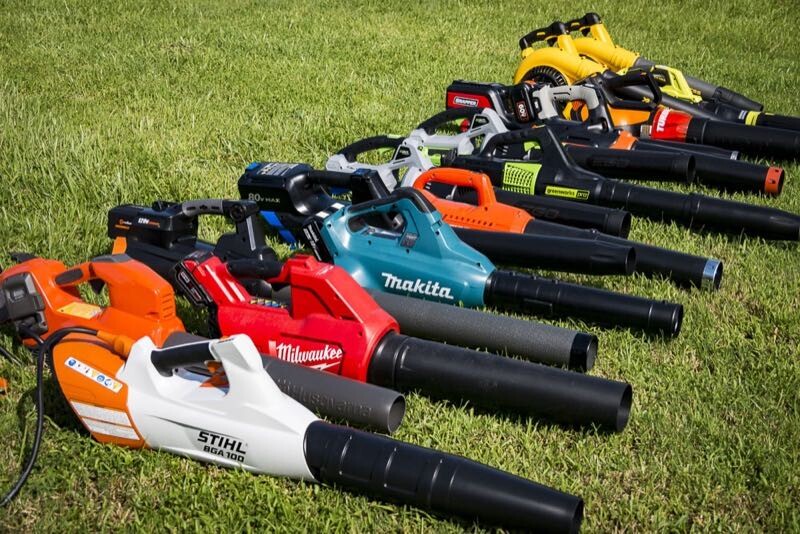
Choose your leaf vacuum mulcher / leaf blower
Choose your leaf vacuum mulcher / leaf blower
Autumn is approaching, and with autumn, the leaves fall.
I have chestnut trees at home; it was one of the first purchases I made after, like everyone else, starting with the famous leaf rake.
I tell you right away, this kind of rake is very useful when 3 leaves are fighting a duel, but beyond that, it quickly becomes a hassle.
In addition, I absolutely wanted a leaf mulcher vacuum to be able to feed my composter.
Gas or electric grinder vacuum blower?
The first question to ask is electrical or gas.
⇨ RELATED: https://vk.com/leafvacuummulcher
The gas mulcher vacuum blower
The advantage of the gas, as everyone knows, is that it allows you to cover a large area without having to manage an electric wire or an extension cord which quickly becomes cumbersome when you have circled a tree twice and when the thread comes to an end or has become tangled (perhaps there is an alternative that we will see a little further down). The gas will be preferred for large areas to be covered!
It remains very significant also when one seeks to have a lot of power.
For me, the heat engine has three disadvantages:
• his weight
• the fact that a mixture (oil + gasoline) is required in most cases: 2-stroke engine
• the noise it makes
Added to that, an engine that is only used once a year always has a little trouble starting!
The electric blower vacuum mulcher
I approached it a little higher; the big disadvantage of the electricity is that it drags behind it this damn wire which will get tangled as soon as it is able to do it!
Apart from that, the electricity is very suitable for me and for a small area (in my opinion less than 1000 m²).
Good for the story of the wire; it is still possible to go through models now on battery. Honestly, I don't know what it's worth.
What bothers me with battery-powered tools is that it's often flat when you want to use them! To do with the most recent models.
So in conclusion, for me, you'll understand, it's better to go electric, but it's up to you!
⇨ RELATED: https://mastodon.social/@leafmulcherhq
Leaf Vacuum mulcher, vacuum blower, or vacuum blower grinder?
Again, it all depends on your usage.
Personally, I almost only use the vacuum mulcher.
What interests me the most is really the shredding rate which will allow the shredded leaves to compost much more quickly.
The suction part
The suction flow is expressed in m3/h. It is generally slightly lower than the expelled airflow (blower mode).
Be careful to be able to modulate the suction power because, in the case of pebbles or even acorns, this should not damage the grinding fins.
The blowing part
To know the power of the blower, check the airspeed (km/h), which varies from 150 to 490 km/h, and the airflow (m3/min or l/min), which varies between 8 and 15 m3/min.
The higher these numbers, the faster and farther they can move large volumes of leaves and debris. Be careful, however, that the power is adjustable.
If, like me, you have a lawn part and a gravel part, the full power will quickly send the gravel to the lawn.
The grinding part
For me, the most important part, you will understand.
⇨ RELATED: https://flipboard.com/@bestleafvacuum
You have to pay attention to 2 things on the grinding part:
• the shredding ratio (the higher it is, the more the leaves will be reduced at the output)
• Know the grinding fin material and avoid plastic fins as much as possible.
That's what I think you should pay attention to when choosing a vacuum blower grinder.